
QC and shipping, between the two bills
Arrived items become photos, photos become a decision, and the decision meets each line's own weight rules.
Inspection photos: the mechanism, with an honest note on counts
When ordered items reach the warehouse they are inspected and photographed, and the photos appear in your account for review before anything flies. The operator's own fine print narrows the promise usefully: purchases from 1688 follow a different inspection standard, and the check is a general one - electronics are not function-tested (their Buy For Me inspection step, read 2026-10-10).
On how many photos: the homepage service card says 3-5 free QC photos while another official surface says unlimited, both read 2026-10-10. This site publishes the mechanism and leaves the count variable; what matters to a batch is that every arrived item produces reviewable pictures, listed per order in the warehouse view.
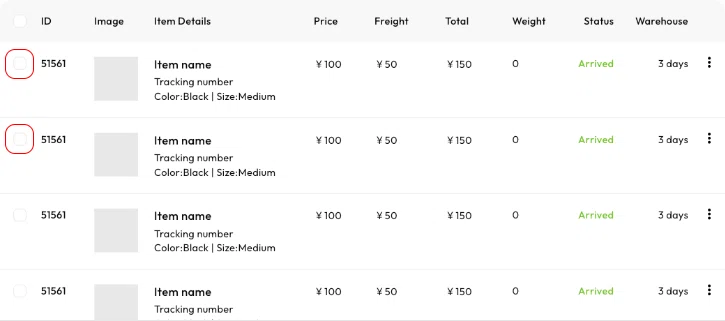
The saved link list becomes your warehouse checklist
Use one row per ordered variant, even when several rows share the same product URL. Match the order identifier, colour, size and expected quantity before looking at details. The archived warehouse table shows why the specification note matters: an address alone does not say which option you paid for.
If one row is ready and another has not arrived, review the ready item now. Waiting to ship everything together should not delay a question about a wrong size or missing accessory. Record the unanswered detail and send a precise request, such as a clear label view or a measurement with the ruler endpoints visible.
Keep seller-return decisions separate from the parcel plan. Once each item has a documented decision, select the goods for shipping and review the route’s current restrictions and packed measurements. A batch is easier to manage when link preparation, QC approval and parcel submission each have their own checklist.
Reading a photo set before clicking Submit For Delivery
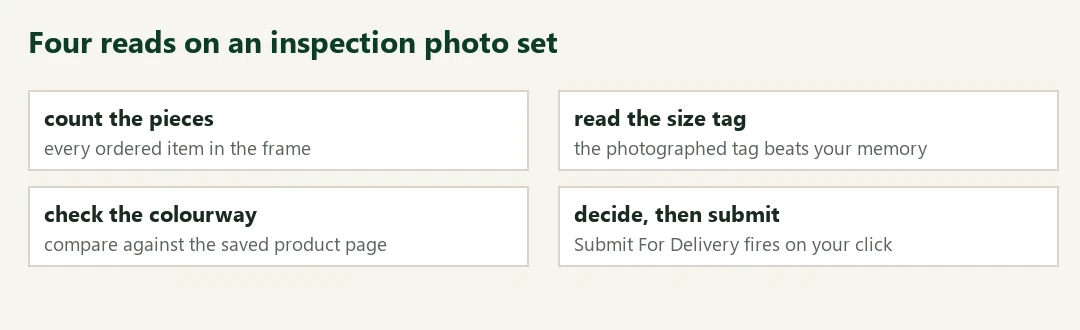
Reading the QC set takes four passes, and none needs the operator's help. Count the pieces against the order. Read the size tag in the photograph rather than trusting your memory of the listing. Check the colourway against the saved product page - which is one more reason the cleaned link list is worth keeping after submission. Then decide: the parcel leaves when you click Submit For Delivery, not before.
When something fails the read, the About page's Quality Checks card gives the window: seven days to return items to sellers when a piece does not meet your standard (read 2026-10-10). Questions that need the seller go through Contact Seller with up to three reference images and a one-to-two business day turnaround, so raise them while the rest of the batch is still arriving.
Shipping: many lines, per-line divisors, one warehouse clock
The homepage card quotes 150+ international shipping lines (read 2026-10-10). Weight rules differ per line, and the operator's surfaces are refreshingly plural about it: help 134 and the archived estimator notes say dimensional weight is divided by 5000, 6000 and so on depending on the line, while live route cards read 2026-10-10 show a 9000 volumetric ratio on a Germany line and 8000 on a Poland line. There is no site-wide divisor, and this site will not invent one; most lines simply charge the greater of actual and volume weight.
Help 134's garment thresholds are the usable part for a clothing batch: jeans under 3.5 kilograms are not volume-weighed, hoodies over 3.2 kilograms are, one 1.5-kilogram down jacket fills a courier bag unless vacuum packed, and boxed clothes over 2.5 kilograms get the volume calculation. Shoes keep the nuance: one or two pairs without boxes escape it, boxed pairs mostly do not.
While you weigh options, the clock from the storage policy runs: 90 days free from the In Warehouse status, 30 for parcels, reduced from 180 effective 2024-06-01 (policy text read 2026-10-10). The updates page tracks that notice.
Next on this site
Costs - the two billing moments around the warehouse stay
Batch guide - the submission method that fills the warehouse well